
Balancing form and function in the age of net zero and new reforms

An incoming new UK government last year heralded significant moves for infrastructure development including a pledge to fast-track planning decisions on several key projects. But to what extent could this impact the early conceptional design process, from approaches to form and function to project-critical social and environmental considerations?
As the countdown to net-zero intensifies, and, in the face of renewed UK planning legislation and a changing new world order, we invited founder of Knight Architects, Martin Knight, to share his thoughts on the principles of careful, considered infrastructure design.
The UK government’s Plan for Change spelt out a commitment to economic growth by fast tracking 150 major infrastructure projects by the end of this Parliament. A bold move, and as reported in the policy paper ‘Planning Reform Working Paper: Streamlining Infrastructure Planning’, could mean the tripling of expediated projects from the previous Parliament plus delivery of “a faster, more certain, and less costly Nationally Significant Infrastructure Projects (NSIP) regime”. [1]
Since then, a ‘pipeline’ of projects has been confirmed in the UK’s new Infrastructure Strategy (June 2025), providing a 10-year view on opportunities and project possibilities. Growth of this magnitude is a positive sign of commitment to change and, equally so, the potential for speeding up the planning consent process which currently sits, on average, at over four years. But responding properly to change from reforms without compromising sustainability objectives or well-thought-out design aspirations, will be crucial.
Infrastructure in the spotlight
Transportation infrastructure, in particular, is incredibly influential. Designed with care and respect, it can improve quality of life, forge connections, drive economies and help to define an enduring sense of place. It is therefore vital that any new pipeline of infrastructure projects is curated to support change in the right direction.
There are several ways we see this being achieved, from adopting visionary, long-range thinking to comprehensive pre-planning strategies and embracing best-practice from other countries or sectors.
Traditionally infrastructure projects, from pylons and railways to bridges and low-traffic neighbourhoods, are often the most controversial of schemes eliciting strong opposition in local communities. This is particularly the case when the benefits are not seen locally but at a regional or national level. Implementing good design at the very earliest stages of a project, along with the early involvement of the local community in the design and planning process, helps generate consensus and support, smoothing the progress towards planning approval.
There is an argument that historically in the UK we have often asked too little of infrastructure, seeing it largely in terms of its economic benefits rather than its wider social, cultural, and environmental impact.
The metrics are gradually changing though, with social value and place-making benefits increasingly recognised and of greater importance in investment decisions.
“Understanding and investing in this evolving value proposition is crucial and requires a truly holistic design approach that speaks to each and every metric from the outset.”
Alongside the mid-to long-term benefits, enabling infrastructure often has too narrow a focus on function that comes at the expense of good design and ingenuity.
It can place an emphasis on standardisation and the repetition of what has already been done — independent of the unique context of each site — with the aim of (theoretically) de-risking processes and reducing costs. But this is a false economy. In fact, good design can cut costs, and the earlier that quality design takes place, the better. We call this ‘infrastructure that over-delivers’.
Best practice learnings and planning
From our international experience over the last 19 years, we have seen that every good planning system strikes a sensible balance between protection and change, more specifically:
Protection
Bridges have a design life of 120 years with some structures, like our Kruunusillat scheme in Helsinki, designed to last 200 years. Infrastructure schemes will usually remain features of the urban realm long after their designers are gone, placing a significant responsibility on both designers and the planning system to get it right. The UK planning system is designed to protect against big mistakes and, as reform filters through the system, it is important it continues to hold significant transportation schemes to a high standard that will stand the test of time.
Change
Just as designers and the planning system have a responsibility to protect, we also have a responsibility to advocate for change. Making lives better now also means making lives ‘lighter’ in terms of carbon, so that future generations have a chance to live as comfortably as we did. For designers in the transport sector, that includes developing Active Travel as a viable and attractive alternative to private car use, accelerating modal shift.
That said, people naturally resist change so effective planning systems should facilitate the suspension of disbelief. While promoting a modal shift is often initially unpopular, it typically gains acceptance quickly and soon becomes an indispensable part of daily life. The New Towns initiative, for example, represents a unique opportunity to design places for future generations who are typically poorly represented in current town-hall meetings. Good design can illustrate how the future will be, to overcome opposition and inertia.
As it evolves, we hope the UK planning system, and the designers who use it, take the ‘long view’ in both regards.
Appetites for investment
Looking beyond UK borders, are appetites towards investment in infrastructure changing? Germany’s plans for investment are of particular interest, where, following a general election, there seems to be a disparity between green priorities and climate protection and aspirations for economic growth and development.
Economically, Germany is a central transit hub with heavy international road traffic using its infrastructure. Most notably this puts a heavy toll on all bridges in former west Germany and major road bridges, many of which were built between 1950-1970, are in especially critical condition and in need of replacement within the next ten years.
Despite Deutsche Bahn’s strong international reputation, the rail network has also suffered from decades of underfunding.
Affluent, visionary German cities, such as Hamburg, Munich and Cologne, are taking a longer-term, climate-focused view investing in a transition into sustainable infrastructure, building cycle superhighways and expanding tram networks.
This need for infrastructure refurbishment is backed by budgets allocated by the German government, such as the EUR 500bn national infrastructure fund approved in 2025. However, bureaucratic hurdles and understaffed authorities are delaying the procurement of those projects. Moreover, German engineering companies are overwhelmed with the volume of work, which brings long-term opportunities for overseas companies keen to enter the German market.
Form, function and future preservation
As architects, the act of balancing form and visual appeal with function and purpose is central to our work. But nowadays this must be considered within a broader framework of planning reforms, geopolitical discord, economic limitations, social inequalities and heightened environmental challenges, including the climate crisis, changing eco-systems and the need for adaptation.
What is the key to effectively balancing everything?
1. Take the long view
At our recent panel discussion at the UK Real Estate Investment and Infrastructure Forum (UKREiiF), speakers discussed the concept of being good ancestors, something which requires a ‘zoomed out’ view. And the Zoom Out is about timing: taking a long, long view. The balancing act between budget, design integrity and net-zero require the greatest amount of creativity and projecting that as far into the future as possible.
“We should be adopting lifecycle value thinking rather than just focusing on upfront costs.”
2. Build in modularity and adaptability
We should be designing infrastructure that can evolve with changing technology and usage patterns. This approach protects financial investment whilst maintaining design quality as we transition to net-zero transport systems.
3. Striking design can still be sustainable
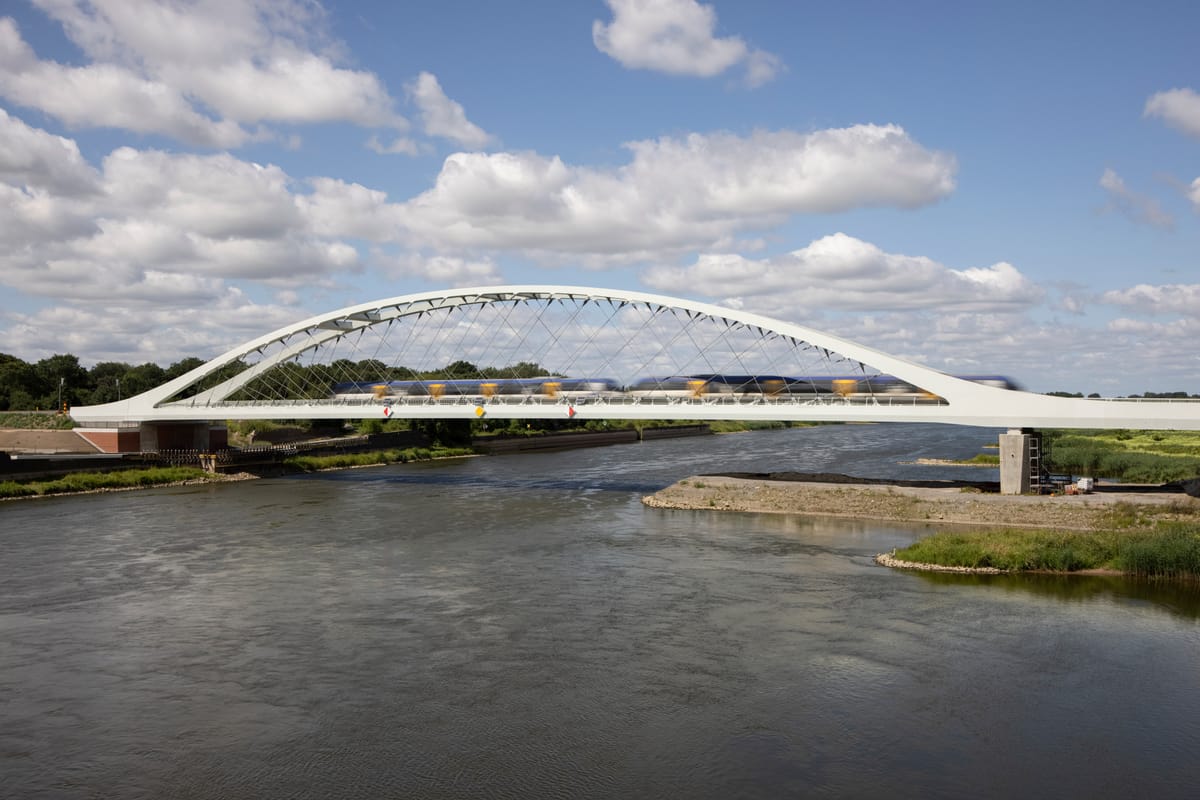
Described as “elegant” and praised for its “structurally pioneering use of an innovative material” the Küstrin-Kietz Rail Crossing, which recently secured the prestigious Deutscher Brückenbaupreis 2025, is a strong example of a project going beyond function yet still managing to marry a striking aesthetic with sustainable, carbon-positive credentials.
Making action matter
Design philosophies have evolved over time, in response to changing technologies and socioeconomic influences, and this will no doubt continue even as AI and new digital solutions make greater strides in society.
But the basic principles of good design – understanding need, articulating purpose and creating aesthetic value - will stand the test of time. And, in the race to net-zero, keeping all these elements in check and in balance is what matters the most for meeting the needs of both people and planet.
Martin Knight is one of the leading UK architects specialising in the design of bridges and transport infrastructure and is a Fellow of the RIBA and the Institution of Civil Engineers and an Honorary Fellow of IStructE.
He founded international bridge designers Knight Architects in 2006 and his award-winning practice has completed more than sixty bridges in the UK and internationally. Their approach to design has been hailed as exemplary by bodies including the National Infrastructure Commission and the Design Council in the UK and Baukultur Bundesstiftung in Germany. Current projects include major schemes in the UK, France, Germany, Finland, Norway, US, Canada and New Zealand.
Martin frequently serves as a client and industry advisor, including as member of the Design Review Panel of the Design Commission for Wales since 2006. He is a member of the National Highways’ Strategic Design Panel, was appointed a Design Council Ambassador in 2021 and is a judge for the BCIA Awards and the Structural Awards.
[1] Policy paper: Planning Reform Working Paper: Streamlining Infrastructure Planning: https://www.gov.uk/government/publications/planning-reform-working-paper-streamlining-infrastructure-planning/planning-reform-working-paper-streamlining-infrastructure-planning